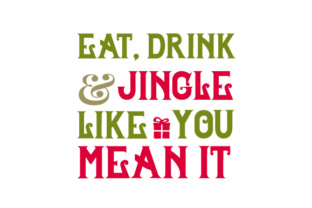
Eat, Drink, and Jingle Like You Mean It
A Festive Phrase That Stitches With Personality—Not Just Cheer
First impression? This isn’t another safe, snowflake-dusted “Merry Christmas” script. Eat, Drink, and Jingle Like You Mean It lands with a wink and a clink of glasses—it’s warm, slightly irreverent, and unmistakably human. The layout flows in a gentle arc, like a toast raised mid-party: “Eat” starts left, “Drink” rises center, “Jingle Like You Mean It” curves right with playful emphasis on “Jingle.” There’s no heavy ornamentation, no crowded holly or overworked bells—just confident lettering, subtle swashes, and intentional spacing that breathes when stitched.
Real-World Test: A Holiday Tote Bag for My Local Bakery’s Pop-Up
Last week, I prepped a batch of canvas tote bags for a neighborhood bakery’s holiday market stall. They wanted something joyful but not cutesy—something that felt handmade, not mass-printed. I chose Eat, Drink, and Jingle Like You Mean It for the front panel (7” wide hoop), paired with a small cinnamon roll icon in the corner. On medium-weight natural canvas, with tear-away + cut-away stabilizer combo, it stitched cleanly in under 8 minutes. The satin-stitched letters held crisp edges, and the slight curve kept the phrase from feeling rigid—even after three rounds of ironing and folding for display, the embroidery stayed smooth and legible. Customers paused, smiled, and said things like, “That’s *us*,” or “I need this for my ugly sweater party.” That’s the signal: this design doesn’t just decorate—it connects.
Where It Shines (and Where It Asks for Thought)
Eat, Drink, and Jingle Like You Mean It excels on stable, medium-to-heavy fabrics where stitch definition matters: sweatshirt embroidery, aprons, tea towels, pillow covers, and embroidered patches meant for denim jackets or backpacks. Its rhythm works especially well on curved surfaces like caps—just mirror the curve in your placement and keep the topmost “E” and final “t” clear of seams. For baby embroidery? Use it on knit cotton blankets or nursery wall hangings—but scale down only if your machine handles fine satin stitch at 3.2mm height without skipped stitches.
Proceed with care on stretchy fabric (like jersey t-shirts) unless you’re using high-quality cut-away stabilizer and reducing top tension. On dark fabric, avoid light thread unless you’ve tested coverage—some satin-stitch sections (especially the “g” in “Jingle”) rely on density to read clearly. And skip it for tiny hoops under 4”: the lowercase “i” dots and inner counter spaces in “Drink” shrink into ambiguity before 5” width.
What It Adds to Your Finished Product—Beyond the Thread
This isn’t just a machine embroidery design—it’s a tone-setter. When stitched onto a linen kitchen towel, it elevates utility into personality. On a custom sweatshirt for a holiday pop-up, it signals authenticity over algorithmic cheer. Buyers notice that difference: Etsy sellers tell me customers comment on how “real” and “unforced” the phrase feels compared to generic holiday slogans. That builds trust—not just in your craft, but in your curation. It also strengthens brand consistency for small shops: pair it with a simple monogram or food-themed icon (a mug, a sprig of rosemary), and you’ve got cohesive design assets across mugs, tags, and packaging.
Giftability? High. It reads warmly without leaning into kitsch—ideal for wedding gifts (“Eat, Drink, and Jingle Like You Mean It… at Your Reception!”), hostess presents, or even corporate holiday swag for creative teams. Just avoid pairing it with overly formal fonts or stiff layouts; its charm lives in contrast and ease.
Practical Designer Notes Before You Stitch
- Always test first—run Eat, Drink, and Jingle Like You Mean It on scrap fabric matching your final project’s weight and weave. Check how the “J” loop and “g” tail land, especially near edges.
- Review stitch density: it’s balanced, but dense enough to hold on textured fabrics like terry cloth towels—just confirm your machine isn’t flagging tension warnings during the fill-stitch phases.
- Thread colors matter more than usual: contrast is built into the shape, not just color. Try charcoal grey on oatmeal linen, navy on cream cotton, or burgundy on ivory twill—avoid pastel-on-pastel combos unless you’ve verified coverage.
- Hoop size matters: the full phrase needs at least a 5” x 7” hoop for clarity. If you’re adapting it for a cap front, isolate “Jingle Like You Mean It” and reposition as a single line.
- Stabilizer choice is non-negotiable: use medium cut-away for knits, tear-away + light cut-away for stable wovens, and avoid basic tear-away alone on anything with drape.
- Check licensing before selling: if you’re an Etsy seller or craft business owner, verify whether the embroidery file permits commercial use of finished products—and whether digital resale (e.g., bundling it with other designs) is allowed.
- Mock it smartly: drop Eat, Drink, and Jingle Like You Mean It into black-and-white printable mockups first. If it loses impact in grayscale, adjust thread contrast or simplify accents before stitching.
Final Thought: It’s Not Just for Christmas—It’s for People Who Love the Season, Not Just the Schedule
I’ve stitched hundreds of holiday embroidery files—some intricate, some minimalist, many forgettable. Eat, Drink, and Jingle Like You Mean It stands out because it doesn’t shout “Christmas.” It whispers “celebration,” “togetherness,” and “intentional joy”—qualities that translate across projects, seasons, and audiences. Whether you’re embroidering a last-minute personalized gift or building a signature line of boutique merchandise, this design earns its place not by being festive, but by feeling true. That’s rare. And that’s why it stays in my working folder—not as seasonal decor, but as reliable design language.